
To compare AI models properly you need the same question, at the same time, with the same settings. Almost every AI model comparison you will read fails at least one of those. This guide is a step-by-step method for an honest AI comparison you can run yourself in about two minutes.
Explain photosynthesis to a ten-year-old.
What makes an AI model comparison fair
- Same question, same words. Retyping introduces differences you did not intend.
- Same moment. Provider load changes speed by seconds. Sequential tests measure the time of day as much as the model.
- No cross-contamination. No model should see another model’s answer before writing its own.
- Same length allowance. A model given twice the budget will look more thorough.
- Your task, not a puzzle. Riddles and trick questions tell you very little about the work you actually do.
Step one: choose three questions from your own week
Not clever questions. Real ones. The email you had to rewrite, the thing you had to explain to a colleague, the calculation you did not trust. Three is enough to see a pattern and few enough that you will actually do it.
Step two: ask all of them at once
On the compare page every configured family is switched on and answers in parallel. The strip along the top shows each family, what it is doing and how many words it has produced.
Step three: read the strip before the answers
The strip is the part people skip, and it carries the information you cannot get from reading one answer. Who started writing first. Who is still going. Who wrote 40 words and who wrote 300. That is a fair description of each family’s habits before you have read a single sentence.

Explain photosynthesis to a ten-year-old.
DeepSeek
27.3 s ✓Photosynthesis is how plants make their own food. It’s like a tiny kitchen inside their leaves!
Here’s what they use:
- Sunlight – the energy from the sun
- Water – they drink it up through their roots
- Carbon dioxide – a gas in the air that we breathe out
The plant mixes these three things together in its leaves. The leaves have a special green stuff called chlorophyll (that’s what makes them green). It acts like a solar panel to catch the sunlight.
When the plant mixes sunlight, water, and carbon dioxide, it makes:
- Sugar (glucose) – this is the plant’s food. It uses it for energy to grow, just like you use food for energy.
- Oxygen – this is a gas that the plant lets out into the air. And guess what? That’s the oxygen you and I breathe!
So, plants are like nature’s food makers. They take sunlight and air and turn it into food for themselves and clean air for us. Pretty cool, right?
Qwen
6.2 s ✓Imagine that plants are like tiny chefs, but instead of using ingredients from a grocery store, they make their own food right inside their leaves! This process is called photosynthesis.
Here’s how it works:
- The Ingredients: Plants need three things to make food:
- Sunlight: The energy source (like the electricity for an oven).
- Water: They drink this up through their roots.
- Carbon Dioxide: This is the air we breathe out. Plants "breathe in" carbon dioxide through tiny holes in their leaves.
- The Kitchen: Inside the leaves, there are special green parts called chloroplasts. You can think of them as little solar-powered kitchens. They contain a green stuff called chlorophyll, which helps catch sunlight.
- The Cooking: Using the energy from the sun, the plant mixes the water and carbon dioxide together. It’s like baking a cake!
- The Result: When the "cooking" is done, the plant makes two things:
- Sugar (Glucose): This is the plant’s food! It uses this sugar to grow big and strong.
- Oxygen: This is what we breathe! So, when you see a plant, remember that it’s giving you fresh air to help you live.
So, next time you see a flower or a tree, know that it’s busy making its own lunch using sunshine, water, and air—and helping us breathe at the same time! 🌱☀️💧
GLM
no answerMiniMax
3.6 s ✓How Plants Make Their Own Food! 🌱
Imagine if you could just stand outside, soak up sunshine, and never have to eat lunch. That's basically what plants do! The way they do it is called photosynthesis, which is a big word that just means "putting things together with light."
The Recipe 🌞
Plants are like tiny kitchens, and they need three ingredients to cook up their food:
- Sunlight ☀️ — This is their stove! It gives them the energy they need.
- Water 💧 — Their roots suck this up from the soil, like drinking through a straw.
- Carbon dioxide 🌬️ — This is a gas that's floating around in the air. Plants breathe it in through tiny holes in their leaves (kind of like how you breathe through your nose).
What Happens Inside the Leaf? 🍃
Inside the leaf, there's a special green ingredient called chlorophyll (say it like "KLOR-uh-fill"). This is what makes plants green! It catches the sunlight, like a solar panel, and uses it to mix the water and carbon dioxide together.
After mixing everything up, the plant makes two awesome things:
- 🍬 Sugar — This is the plant's food! It gives the plant energy to grow big
GPT-OSS
3.0 s ✓What is Photosynthesis? Plants turn sunlight into food—just like how a kitchen turns ingredients into a meal.
—
1. The Main Ingredients
| Ingredient | Where it comes from | Why it matters |
|---|---|---|
| Sunlight | The sun | Gives the energy needed to cook the food. |
| Water (H₂O) | Soil or rain | Provides the “water” that plants drink. |
| Carbon dioxide (CO₂) | Air | The “air ingredient” plants need to grow. |
| Chlorophyll | Green leaves | The plant’s kitchen that captures sunlight. |
—
2. How the Kitchen Works
- Sunlight enters the leaf
The green pigment called chlorophyll grabs the sunlight.
- Water is pulled up from the roots
Roots absorb water from the soil, and it travels up through the plant to the leaves.
- Carbon dioxide enters the leaf
Tiny holes in the leaf called stomata let CO₂ in from the air.
- The plant mixes the ingredients
Inside the leaf’s tiny cells, the plant uses the energy from sunlight to combine water and CO₂.
- Food (glucose) is made
The reaction produces glucose, a sugar that plants use for energy and growth.
- Oxygen is released
As a by‑product, the plant sends oxygen back into the air for us to breathe.
—
3. A Simple Equation
Sunlight + Water + CO₂ → Glucose (food) + O₂ (oxygen
Step four: pin two answers side by side
Click one family to read it. Click a second and it opens beside the first. Reading two answers in parallel is the single most useful thing in a comparison, because differences that are invisible in sequence are obvious side by side.
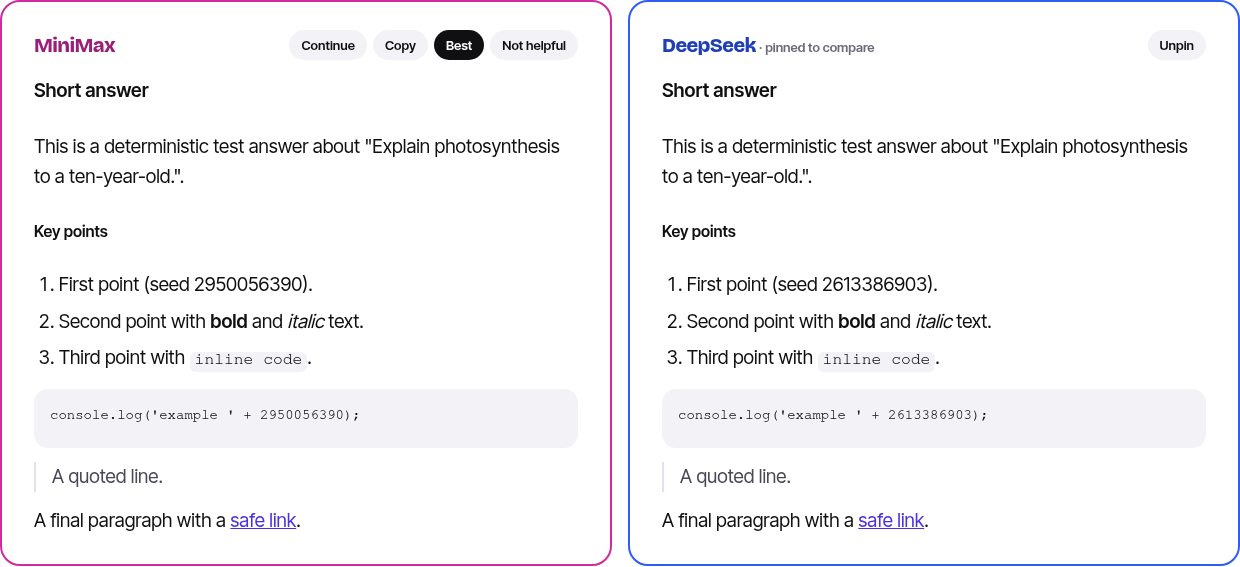
Look for the sentence where they stop agreeing. That sentence is your whole verification task.
Step five: mark the best one, and be honest about why
The compare page has a Best and a Not helpful button on every answer. Use them for yourself, not for us. After three questions you will usually find you are choosing on length and tone rather than correctness — which is worth knowing about your own preferences.
What to look at when you compare AI models
- Did it answer the question asked? Surprisingly often, one family answers a nearby question instead.
- Is the first sentence useful? Or is it a restatement of your question?
- Are the specifics right? Numbers, names, steps. This is where the differences matter.
- Does it say what it is unsure about? A model that flags its assumption is more useful than one that sounds certain.
- Would you send it? For writing tasks this is the only test that counts.
Mistakes that make a comparison meaningless
- Asking each model on a different day and comparing the speed.
- Using a trick question and concluding something about ordinary work.
- Judging by length. Longer is not better; it is just longer.
- Testing once. Answers are sampled, so a single run can be unrepresentative. Ask twice.
- Ignoring the failures. A family that answers brilliantly nine times and errors on the tenth has a real cost.
If you want the observable numbers rather than a method, the comparison chart collects them from every run on this site.